An emerging new paradigm in development
To fully leverage AI in software development, a team needs more than powerful coding assistants. It needs a methodology. Without one, AI adoption often produces only personal productivity gains: individual developers generate code faster, write tests faster, or explore solutions faster. These gains are real, but they do not automatically translate into higher team-wide throughput or improved quality.
The reason is simple: software delivery is a system, not a collection of isolated typing tasks. Team performance depends on shared understanding, architectural alignment, quality review, testability, security, governance, and the ability to integrate work safely. If AI improves personal productivity without improving these surrounding activities, the bottleneck simply moves elsewhere: to clarification, review, rework, integration, or production risk.
Traditional software development often starts from, informal or high level requirements, even direct coding just after sharing a general vision. This works when the problem is small, the team shares enough context, and the implementation path is obvious. But as systems grow, ambiguity becomes expensive. Different developers may interpret the same requirement differently. Edge cases are discovered late. Security and governance rules are applied inconsistently. Tests often reflect what was implemented rather than what was intended.
AI coding assistants amplify the problem. When the specification is clear, AI can accelerate development by generating code, tests, documentation, and refactorings aligned with the desired outcome. When the specification is vague, AI simply produces plausible output faster. The result may look correct while silently embedding misunderstood requirements, weak assumptions, or architectural drift. Every attempt to re-generate code will produce a different outcome.
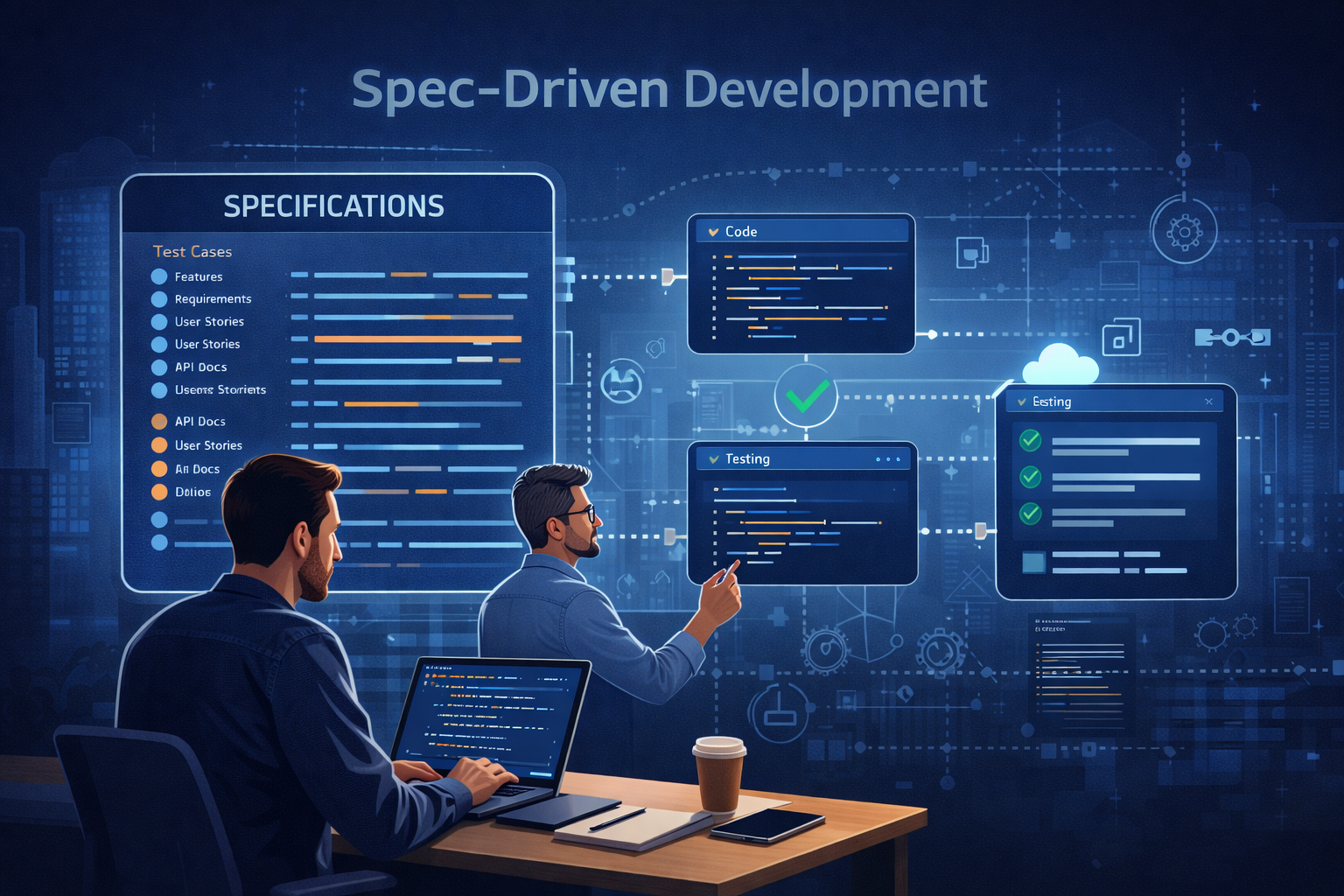
This is where spec-driven development becomes important. It provides a structured methodology for turning intent into executable engineering context. Before code is written, the desired behavior, constraints, architecture, risks, and acceptance criteria are captured in a specification. That specification is not treated as a static document produced for compliance or handoff. Instead, it becomes a living artifact that guides implementation, review, testing, and evolution of the system.
The primary engineering activity becomes the creation of high-quality specifications that are precise enough to guide humans and machines alike. These specifications typically include functional behavior, non-functional requirements, data models, interfaces, security constraints, observability expectations, and explicit acceptance criteria.
In this model, the specification acts as a shared source of truth. Developers use it to understand what must be built. AI assistants use it as context for generation. Reviewers use it to evaluate whether the implementation satisfies the original intent. Test suites can be derived from it. Governance rules can be embedded directly into it. Instead of relying on tacit knowledge scattered across people, meetings, and code comments, the team makes intent explicit and versioned.
This changes the role of the developer. The developer is no longer only a producer of code, but also a designer of constraints, a curator of context, and a reviewer of machine-generated output. The quality of the system increasingly depends on the quality of the specification: what it includes, what it excludes, how conflicts are resolved, and how assumptions are documented.
However Spec Driven development clear definition, methodologies and tools are still emerging. Team leaders and software engineers should keep an aye on this evolution to adapt their workflows. Ideally before adopting AI at large.